The Unseen Messiah: Bridging Worlds Through Ancient Jewish Mysticism
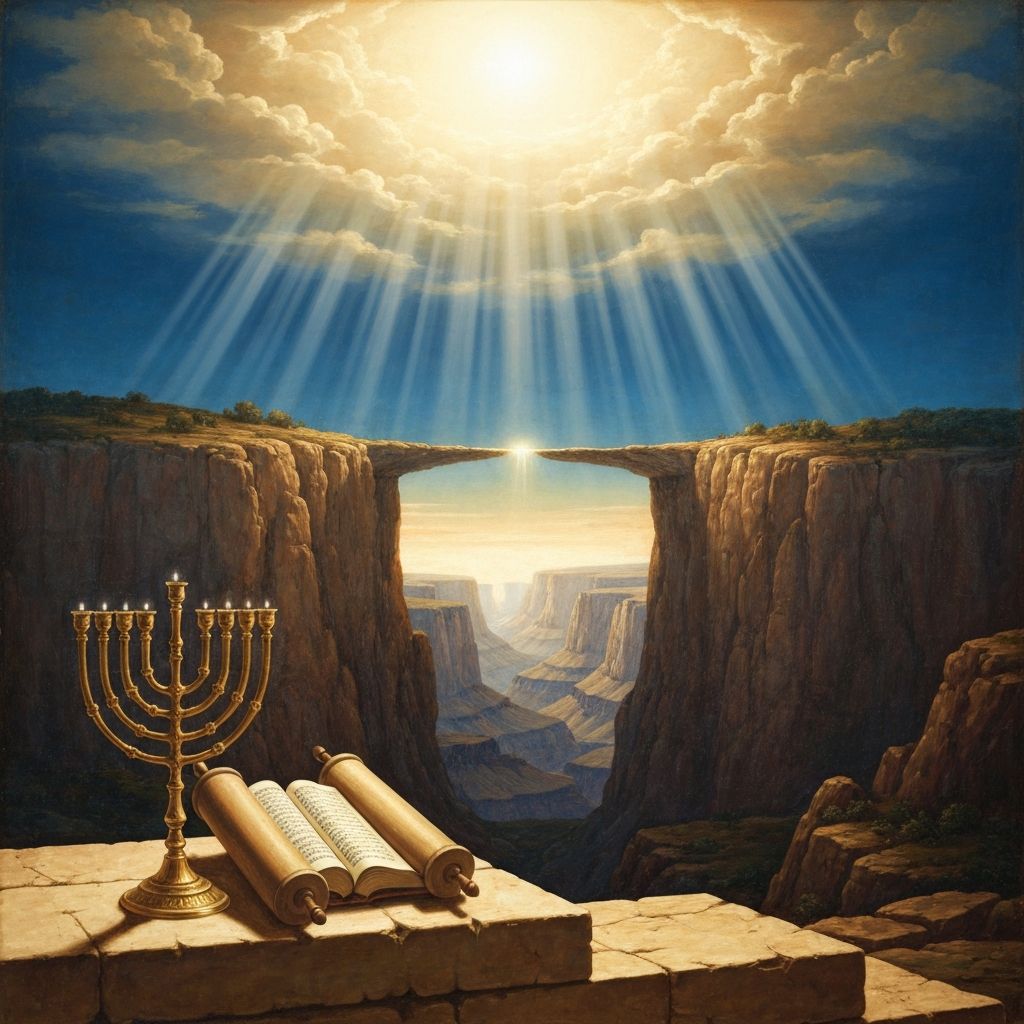
For millennia, the figure of the Messiah has been a cornerstone of both Jewish and Christian faith, yet the understandings have diverged dramatically. But what if, for a moment, we could step back in time? Back to the Second Temple era, a vibrant period where Jewish mystics, sages, and prophets wrestled with profound questions about G-d, humanity, and the ultimate redemption. What if the language used to describe the Messiah—in both Jewish extra-biblical texts and the New Testament—was speaking the same deep, mystical Hebrew?
The Jewish Messiah: Not Just a King, But a Cosmic Event
Let’s first consider the traditional mystical Jewish understanding of the Messiah (Mashiach). In Judaism, the Messiah is far more than a political leader. He is the culmination of creation, the human vessel through whom the world finally achieves its intended perfection.
- The Neshama Clalit (The Collective Soul): Imagine humanity as a vast, intricate body. The Mashiach is not just one limb, but the Collective Soul—the spiritual “head” or “heart”—that encompasses and unifies every other soul. As the Zohar teaches, his soul is a mirror reflecting the entirety of Israel. This means his actions, his suffering, and his triumphs resonate through every fiber of the Jewish people and, ultimately, the world.
- The Keli and Kavod (Vessel and Glory): This is where the finite meets the Infinite. Jewish mysticism teaches that G-d’s infinite light (Ein Sof) is too intense for the finite world. It must contract (Tzimtzum) and then manifest through vessels (Kelim). Mashiach, through his profound self-nullification (Bittul), becomes the ultimate Keli—a transparent vessel that perfectly reflects G-d’s light (Kavod). He is not seen as becoming G-d, but he becomes so utterly aligned with G-d’s will that the Divine Presence shines through him without obstruction. He is like a perfectly clean window, allowing the sun’s light to illuminate a room so completely that you feel the sun’s warmth, even though the window itself is just glass.
- Adam Kadmon (Primordial Man): This Kabbalistic concept describes the archetype of humanity before the “fall.” Mashiach is seen as the restoration of Adam Kadmon—the original, unblemished spiritual blueprint of Man. He is not just a man, but the ideal Man, embodying what humanity was always meant to be. This ties into the idea of his “name” existing before creation, as seen in the Talmud (Nedarim 39b), which lists the Name of Mashiach as one of seven things created before the world. This means the idea of redemption, the perfect human, was part of G-d’s original design, not an afterthought.
- Holding the “Keys” of Hashem: The Talmud (Ta’anit 2a) states that three “keys” remain solely in G-d’s hand: rain, childbirth, and the resurrection of the dead. Yet, prophets like Elijah and Elisha were “lent” the key of resurrection. Mashiach, as the greatest of all prophets, is understood to be the one through whom G-d will ultimately bring about the resurrection of the dead (Techiyat HaMetim), not through his own inherent power, but as G-d’s chosen conduit for this ultimate miracle.
- The Paradox: Clouds and a Donkey: The Talmud grapples with the seeming contradiction in Messianic prophecies: “If Israel is worthy, Mashiach will come with the clouds of heaven (Daniel 7:13); if they are not worthy, he will come as a poor man riding on a donkey (Zechariah 9:9).” This highlights that the pace and miraculousness of Mashiach’s arrival are contingent on humanity’s spiritual state. According to most Jewish interpretations, he is waiting, in a sense, for us to prepare the way.
- The Suffering “Leper” and the “Two Messiahs”: This is where the prophetic vision becomes most poignant. Early mystical traditions speak of two Messianic forces (Sod Shnei Meshichin):
- Mashiach ben Yosef (MBY): The “Outer Mashiach.” Associated with the initial, often painful, stages of redemption—the ingathering of exiles, building the physical infrastructure, and engaging in spiritual warfare. He is the suffering servant, often described as being “cut off,” “pierced,” or even dying in the battle against the forces of evil (Zechariah 12:10). The Midrash and Talmud speak of Mashiach waiting in exile, even as a “leper at the gates of Rome” (Sanhedrin 98a)—ostracized and unrecognized, bearing the spiritual ailments of his people. Sefer Zerubbabel, an early apocalyptic text, depicts Mashiach in a house of “filth” in Rome, awaiting his call. His suffering is not for atonement, but as a catalyst—his tragic fate is meant to awaken the Jewish people to profound repentance (Teshuvah). He also deals with the material world and the “outer” salvation of the nations—bringing them to the knowledge of the G-d of Israel.
- Mashiach ben David (MBD): The “Inner Mashiach.” He comes after MBY, establishing the final, spiritual, and eternal kingdom. He orchestrates the rebuilding of the Temple and brings about an era of universal peace and knowledge of G-d. It is MBD who is said to oversee the resurrection, completing the work initiated by MBY.
These concepts paint a picture of a Messiah deeply interconnected with humanity’s spiritual journey, a figure of immense spiritual stature who acts as G-d’s ultimate agent in the perfection of the world.
The Jewishness of the New Testament: Reclaiming an Ancient Vocabulary
Now, let’s turn to the New Testament through this Jewish lens. For too long, these texts have been read in isolation from their vibrant Jewish context. But when we view them as Second Temple Jewish documents, written by Jews deeply immersed in these very traditions, new layers of meaning emerge regarding their portrayal of Jesus. For example, we see that its authors were using the four levels of Torah interpretation—PaRDeS—to describe Jesus.
The Four Levels of PaRDeS
P’shat (Literal): Mark is P’shat—A direct, Mishnah-like literal reading of his actions.
Remez (Hint): Luke is Remez—Providing Talmudic “hints” and thematic connections.
Drash (Homiletic): Matthew is Drash—A Midrashic sermon reading, constantly tying events back to prophetic verses.
Sod (Secret): John is Sod—Acts as a “Zohar” reading, focusing on the mystical Memra (Word) and the hidden nature of the soul.
Raza de Razin (Secret of Secrets): Revelation is Raza de Razin—Pure apocalyptic Kabbalah.
Then, when we consider the New Testament writers’ description of Jesus and his life, we see these connections with Jewish traditions around the Messiah:
- The “Word Made Flesh” (Memra and Hitlabshut): When John opens his Gospel with, “In the beginning was the Word, and the Word was with G-d, and the Word was G-d... and the Word became flesh,” (John 1:1, 14), he is using terminology that echoes the Aramaic Targums. These ancient Aramaic translations often replaced “G-d” with Memra (The Word) when describing G-d’s interaction with the physical world. For John and other Jewish writers, Jesus, as the “Word made flesh,” could be seen as the ultimate Hitlabshut—the complete enclothing of the Divine Word/Torah/Wisdom in a human Keli, making the Divine Presence tangible in the world. It’s the ultimate expression of the “window” becoming so perfectly clean that the sun’s light is fully manifest through it. You can’t tell where the window begins and light ends. Or maybe it’s better understood as a bat held in a hand being perceived by the brain as an extension of the arm. Is it a bat or is it an arm? Or possibly the solar rays from the sun, which aren’t the sun exactly but are a manifestation of the sun’s heat in a way that we can interact with and feel on Earth. In this way, Jesus is portrayed as fully human yet also the highest possible manifestation of the divine essence, a direct expression of G-d’s will, and the Diukna (the Image) of G-d.
- The “Last Adam” and the Neshama Clalit: Paul’s designation of Jesus as the “Last Adam” (1 Corinthians 15:45) directly mirrors the concept of Adam Kadmon. If the first Adam’s fall affected all humanity, then the “Last Adam” is the archetypal human who reverses that spiritual damage. Similarly, the idea of Jesus embodying Israel—coming out of Egypt (Matthew 2:15), spending 40 days in the wilderness (echoing Israel’s 40 years), and being called G-d’s “firstborn son” (Exodus 4:22 for Israel, Hebrews 1:6 for Jesus)—can be seen as his fulfilling the role of the Neshama Clalit. As the Collective Soul of Israel, he acts on behalf of the entire people, perfectly representing them and their covenant with G-d. Jesus does not replace Israel; rather, as a High Priest, he represents his people and all humanity perfectly before G-d. He relives Israel’s history—but he does so without fault. He is the “True Israelite,” the perfect example of who the nation is meant to be.
- The “Son of Man” on the Throne (Daniel, Enoch, Metatron): The New Testament frequently calls Jesus the “Son of Man” (e.g., Mark 14:62, Matthew 26:64), directly referencing Daniel 7. The description of this “Son of Man” ascending to the Ancient of Days and receiving “authority, glory and sovereign power” (Daniel 7:14) was already being interpreted in extra-biblical texts like 1 Enoch as a specific, pre-existent, celestial figure.
1 Enoch 48:2-3, 6: “At that hour that Son of Man was named in the presence of the Lord of Spirits... Even before the sun and the signs were created, before the stars of heaven were made, his name was named...” This echoes the Talmudic idea of Mashiach’s name existing before creation.
The NT depiction of Jesus sitting at the “right hand of G-d” (e.g., Hebrews 1:3, Mark 16:19) ties into the concept of Metatron—the “Prince of the Presence” in Jewish mysticism, sometimes called the “Lesser YHWH,” who sits on a throne and carries divine authority as a messenger, without being G-d Himself. For the NT writers, this was the ultimate human promotion, a man elevated to the highest possible delegated authority.
- The Two Mashiach Made One— The Suffering Servant (Mashiach ben Yosef) and the “Leper” Messiah: The portrayal of Jesus’s suffering, rejection, and crucifixion aligns powerfully with the traditions of Mashiach ben Yosef. He is “pierced” (John 19:34, referencing Zechariah 12:10), despised, and “cut off.” The idea of the Messiah being “hidden” or “in exile”—like the Mashiach in the “house of filth” in Rome from Sefer Zerubbabel—finds resonance in a figure who is unrecognized by many of his own people and whose kingdom is not yet fully established on earth. From this perspective, the crucifixion, rather than being the end, could be interpreted as the tragic but necessary catalyst for repentance, echoing the death of MBY meant to awaken the nation for the arrival of MBD, which would be perceived as the second coming of Jesus.
- Holding the Keys: The verse in Revelation 1:18, where Jesus states, “I hold the keys of Death and Hades,” is a powerful echo of the Talmudic idea of G-d “lending” the keys of resurrection. For the NT writers, this was evidence of Jesus’s Messianic authority, sometimes interpreted as his inherent divine power. This is a divinely granted mandate to complete the ultimate redemption that is given only to the Messiah.
Moving Forward: Dialogue and Deeper Understanding
By returning to these Jewish roots, we see that the New Testament writers weren’t moving away from Judaism; they were diving into the rich tapestry of Jewish mystical thought, apocalyptic literature, and prophetic interpretation that was common in their era. Understanding the concepts of Neshama Clalit, Keli, Kavod, Adam Kadmon, Bittul, the two Messianic forces, and the hidden “leper” Messiah isn’t just helpful—it is essential to comprehending the world they lived in and the Messiah they expected. It also allows us to gain a far richer appreciation for the intricate, profound, and deeply Jewish conversation that the New Testament represents.
Your Call to Reflection
Take a moment this week to read one of the source texts mentioned above—whether it’s Daniel 7, 1 Enoch 48, or even a passage from the Zohar—and consider how these ancient Jewish voices shaped the world’s understanding of the Messiah. The conversation between Judaism and Christianity is not a wall; it is a bridge built on shared scripture, shared language, and a shared hope for redemption.